
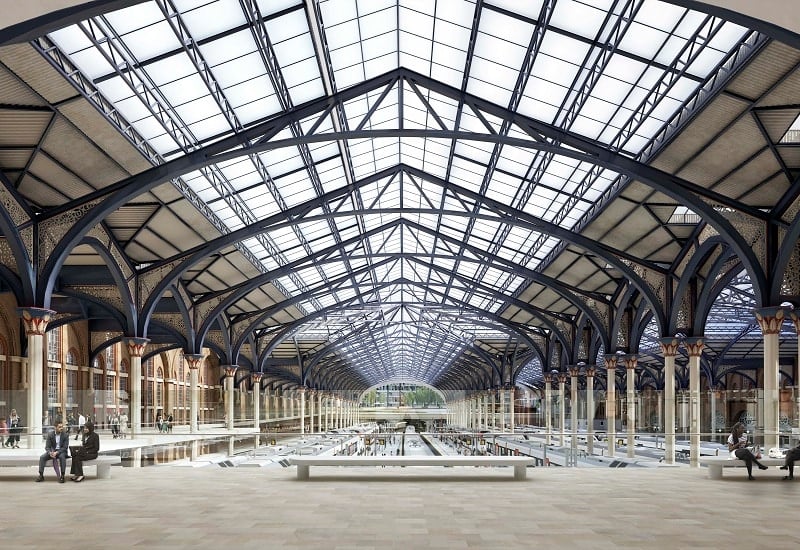
New homes will get a ‘default yes’ when they are built around rail stations, the government announced in its National Planning Policy Framework published today.
Homes built upwards in towns and cities will also generally be given the green light, while there will be a fast-tracking of development schemes.
Despite previous warnings, the government is looking to establish a ‘medium size development’ category for sites between 10 to 49 homes, giving small developers a possible exemption from the Building Safety Levy, a charge introduced by the government to help fund the remediation of residential buildings.
It also said there will be a ‘streamlining’ of energy efficiency standards and Biodiversity Net Gain, which may be a euphemism for watering down green energy rules.
The government has launched a consultation on a revamped National Planning Policy Framework today.
Housing Secretary Steve Reed said: “Right now we see a planning system that still isn’t working well enough. A system saying ‘no’ more often than it says ‘yes’ and that favours obstructing instead of building.
“It has real-world consequences for those aspiring to own a home of their own and those hoping to escape so-called temporary accommodation – we owe it to the people of this country to do everything within our power to build the homes they deserve.
“We’ve already laid the groundwork to get Britain building but our planning overhaul was only the first step to fix the housing crisis we face.
“And today I’m going further than ever before to hit 1.5 million homes and place the key to homeownership into the hands of thousands more hardworking people and families.”
In terms of other revisions, the government said it would be easier for developers – particularly SME builders – to build higher density housing, such as modern apartments and flats, on smaller sites and under-used land where appropriate.
More rural affordable homes and accessible homes for older people and those with disabilities will be encouraged, the government said.
New builds will be expected to have nature friendly features like swift bricks, which support wildlife. These are hollow building blocks with an entrance hole, designed to be built into walls of new or renovated buildings to provide nesting sites for swifts and other cavity-nesting birds.
In addition, developments that strengthen local economies and provide local services like shops, leisure facilities and food production will be given preferential treatment.
Danny Pinder, director of the British Property Federation, said, “It’s good to see the previously announced proposals make it into the draft National Planning Policy Framework.
“It’s particularly welcome to see explicit recognition of the need to plan for older people’s housing, following on from similar recognition of the valuable contribution that Build-to-Rent homes could make to housing supply in last year’s NPPF revisions.
:Housing completions have fallen off a cliff this year so measures that increase planning certainty and support a wider range of entrants into the market – whether SMEs or later living providers – have to be a good thing.
“However, the decision to make national development management policies a non-statutory element of a revised NPPF could undermine that same certainty, and we will need to examine the consultation carefully to assess the potential impact on new development.”